
Technical SEO Liverpool
TECHNICAL SEO FOR GROWING LIVERPOOL BUSINESSES
Technical SEO is bread and butter for us here at Frankenstein Digital. As we provide ecommerce expertise for companies in Liverpool, it is imperative that your website is free from technical issues that can hold growth back.
We work with growing businesses that have outgrown basic optimisation. With over a decade of working on Technical SEO issues we have seen it all from pages not getting indexed, canonical duplications and JavaScript errors rendering your content invisible in the eyes of search engines.
Many technical issues can often be unseen to the eye, and local businesses trust us to audit and implement the fixes required to have your website free from technical issues.
Technical SEO Audits Liverpool
In-depth technical audits for Liverpool ecommerce businesses, uncovering crawl inefficiencies, indexation issues and structural weaknesses holding back organic growth.
Crawl Budget Optimisation
Helping growing Liverpool brands eliminate crawl waste from filters, parameters and low-value URLs so search engines prioritise revenue-driving pages.
Site Architecture Strategy
Structured category hierarchies and internal linking frameworks engineered to strengthen keyword targeting for Liverpool and UK search markets.
Index Control & Canonicalisation
Resolving duplicate content and canonical conflicts across Shopify, Magento and WordPress builds used by Liverpool ecommerce companies.
Core Web Vitals Improvements
Performance optimisation for Liverpool businesses focused on improving page speed, stability and engagement signals that influence rankings.
Structured Data Implementation
Schema markup for products, reviews and organisational data to increase visibility in search results for Liverpool based online stores.
Faceted Navigation Management
Controlling filter-based URLs and dynamic parameters to prevent index bloat on large ecommerce sites operating from Liverpool and beyond.
Ongoing Technical Monitoring
Continuous tracking through Search Console, crawl tools and log analysis to protect and scale organic performance for Liverpool ecommerce brands.
Log File Analysis & Server Diagnostics
Analysing server logs to understand how Googlebot actually crawls Liverpool ecommerce websites, identifying crawl traps, wasted resources and priority gaps that standard audits often miss.
Real Results. Local Businesses.
Ecommerce brands in Liverpool we've helped grow through connected SEO, PPC, development, and automation.
Direct
Scaling Organic Traffic for Liverpool's Largest Bed Retailer
How we helped Bed Factory Direct, a Liverpool-based bed manufacturer and retailer with over 37 years in business, increase organic visibility and drive ecommerce revenue through a connected SEO and development strategy.
Driving Ecommerce Revenue for Liverpool's Iconic Home Store
How we helped Taskers, an established Liverpool home and furniture retailer with over 60 years of history grow their online revenue through an integrated approach spanning SEO, development, and ecommerce optimisation.




CORE WEB VITALS
Core Web Vitals are performance metrics used by Google to measure real user experience. While they are not dominant ranking factors, they form part of Google’s Page Experience evaluation and can influence visibility when competing pages are otherwise similar in relevance and authority.
For ecommerce websites, their impact is often commercial rather than purely algorithmic.
Core Web Vitals focus on three primary metrics:
Largest Contentful Paint (LCP) – how quickly the main content becomes visible
Interaction to Next Paint (INP) – how responsive the page feels during interaction
Cumulative Layout Shift (CLS) – how visually stable the page remains while loading
In ecommerce environments, common issues include:
- Heavy product imagery and unoptimised media
- Render-blocking scripts and third-party tracking tags
- Inefficient theme code and bloated plugins
- Slow server response times
- Layout shifts caused by dynamic content and ads
Improving these metrics does not magically create rankings. However, it strengthens user engagement, improves crawl efficiency, reduces bounce rates and increases conversion rates. When technical foundations are strong, SEO, paid media and CRO efforts perform more effectively.
For Liverpool ecommerce brands investing in long-term growth, Core Web Vitals are part of building a technically stable, high-performing platform that supports both visibility and revenue.
PROVEN RESULTS
We don’t just talk about technical SEO. We practice it on our own site first.
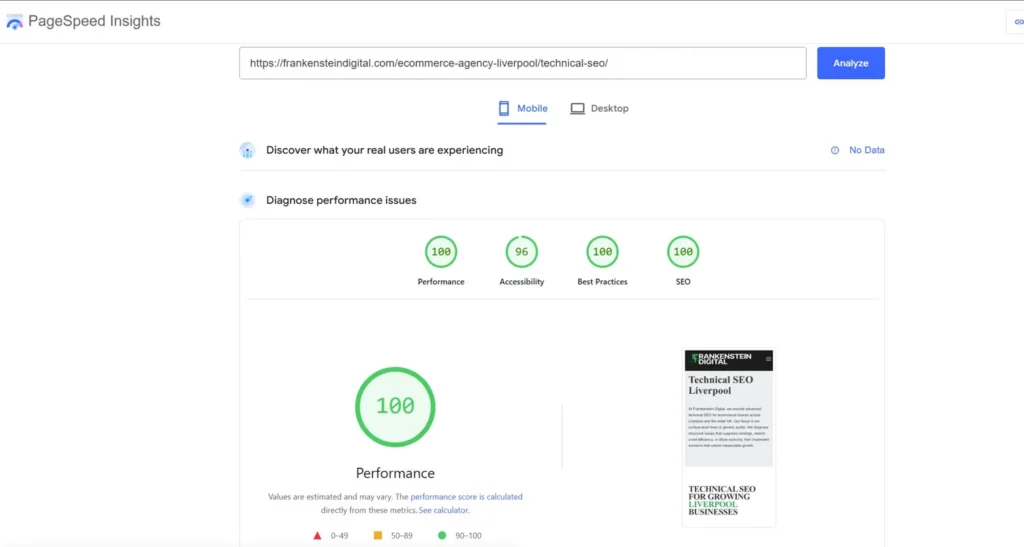
This page scores 100 for Performance, 100 for Best Practices and 100 for SEO on Google Lighthouse – on mobile. Accessibility sits at 96. These aren’t desktop scores on a fast connection. These are mobile scores, where most ecommerce traffic actually comes from.
Most agencies selling technical SEO can’t say the same about their own website.
When we work on your site we apply the same standards. Clean code, fast load times, no bloat, no shortcuts.
If you want to see how your site is performing on a Google Lighthouse test, use the tool below.
Is Your Site Passing
Google's Test?
When Google analyses your site, these are the scores it uses to decide where to rank you. Enter your URL and see exactly where you stand.
Powered by Google PageSpeed Insights API — real field data, not estimates.
PLATFORM SPECIFIC TECHNICAL SEO
Technical SEO is not one size fits all. Every platform introduces its own structural behaviours, crawl challenges and indexation risks. Shopify handles URLs differently to WooCommerce. Headless builds require a rendering strategy. Custom frameworks demand precise routing control.
Effective technical SEO depends on understanding these platform constraints and working within them, not against them. Below is how we approach technical optimisation across the platforms most commonly used by growing ecommerce brands.

Magento
Magento's flexibility comes with technical complexity. Large catalogues create crawl waste, faceted navigation generates duplicate URLs, and multi-store setups introduce canonical conflicts. We resolve the structural issues that hold Magento sites back in search engines.

Shopify Technical SEO
Managing duplicate product URLs, collection paths, faceted navigation and index bloat within Shopify’s structural limitations. We optimise crawl efficiency, internal linking and structured data without compromising platform stability.

WordPress & WooCommerce
Controlling taxonomy duplication, pagination, parameter handling and plugin bloat while strengthening site architecture and performance. Technical SEO aligned with scalable content and ecommerce growth.

Laravel Technical SEO
Custom ecommerce frameworks require precise crawl directives, clean routing logic and structured data implementation. We ensure bespoke builds remain search engine friendly as they scale.

Progressive Web Apps
JavaScript-heavy environments demand careful rendering strategy. We implement server-side rendering, dynamic rendering where needed, and performance optimisation to protect indexation and visibility.

Headless Commerce
Decoupled architectures require strong technical governance. We manage API-driven routing, canonical strategy, structured data and crawl pathways to ensure headless builds remain discoverable and scalable.
Put Your Name
in The Book
Tell us what you need. We'll be in touch within 24 hours.
We'll be in touch within 24 hours.
You're In the Book
Your experiment is about to begin.
Frequently Asked
Common questions from ecommerce brands looking to fix technical issues, improve indexation and build a stronger SEO foundation.
Technical SEO is the work that ensures search engines can crawl, understand and trust your site at scale. For ecommerce, that usually means controlling duplication, improving architecture and internal linking, managing filtered URLs, and resolving indexation issues that stop key categories and products from performing.
No. We are based in Liverpool, but we work with ecommerce brands across the UK. Being local can help for workshops and faster collaboration, but most technical SEO work is delivered remotely with clear reporting, implementation plans and developer-ready recommendations.
Some fixes show impact quickly, such as correcting robots rules, indexation controls, broken canonicals or sitemap issues. Others take longer as Google re-crawls and re-evaluates your site. We prioritise actions that improve crawl efficiency and protect commercial pages first, then build long-term gains through architecture and internal linking.
The most common issues are duplicate URLs, index bloat from filters and parameters, weak internal linking, slow category templates, bloated scripts, and poor canonical strategy. On Shopify we often see duplication across collection paths, and on WooCommerce we often see taxonomy overlap and plugin-driven bloat.
Yes. Faceted navigation is one of the biggest technical SEO challenges in ecommerce. We decide which filters should be crawlable and indexable, prevent crawl traps, and implement the correct combination of internal linking, canonicals, noindex rules and parameter handling so you keep navigation benefits without bloating the index.
They are part of Google’s Page Experience signals, but they are not usually a deciding factor on their own. Where they matter most is competitiveness and commercial performance. Faster, more stable pages tend to convert better and perform more consistently, especially when competing pages are similar in relevance and authority.