You may have heard the words “understanding user intent” before, people often describe it as a key factor in SEO.
If you can understand the intent behind a search, you can optimise the landing pages to satisfy this intent, and this in turn provides a great user experience.
If I search for how to fix a watch, the intent behind my search is obviously to seek information on how to fix watches. Of course, there are many types of watches, but we can safely say the intent behind this search was one of discovery or acquiring information.
Types of intent
Now when we look at types of intent, SEO professionals often categorise intent into different types as:
- Informational
- Commercial
- Transactional
- Navigational
If you use tools such as Semrush, it tags keywords on what it thinks is the intent behind each keyword as above.
If you read Google’s Search Quality Rater Guidelines, you can see the classifications they use, and it differs slightly from the SEO industry’s version.
Google Classifies Intent as:
- Know
- Do
- Website
- Visit in Person
Here are the different intents matched, excluding the Visit in Person element when somebody is looking for directions.
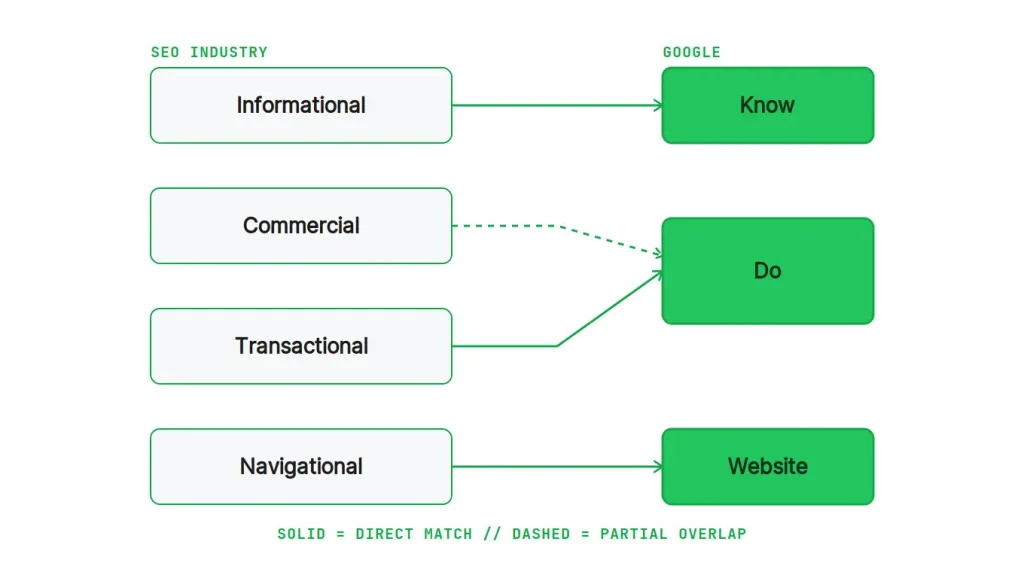
The differences are often semantics; you can use the Informational intent as the same as the Know intent, both users want to know something; they are seekers of information.
Transactional and Do intent overlap; a user wants to complete a transaction or purchase a product.
Navigational and Website is simply a person looking for a website or wanting to navigate to a certain space, this could be a domain name or a particular section of a website, like Argos or Debenhams dresses.
Commercial keywords overlap a bit with Do and Informational intents; the person could be looking to make a purchase but can also be at different stages in the purchase journey.
The Funnel
Now shopping funnels are also a useful way to visualise how people behave throughout their purchasing cycle. At the top of the funnel, they are in discovery mode, and as they move down the funnel, their searches become more specific.
Someone at the bottom of the funnel could use a navigational query as they know exactly where they want to go to make a purchase, but lines can become blurred as different people are at different stages in the cycle.
The funnel is important.
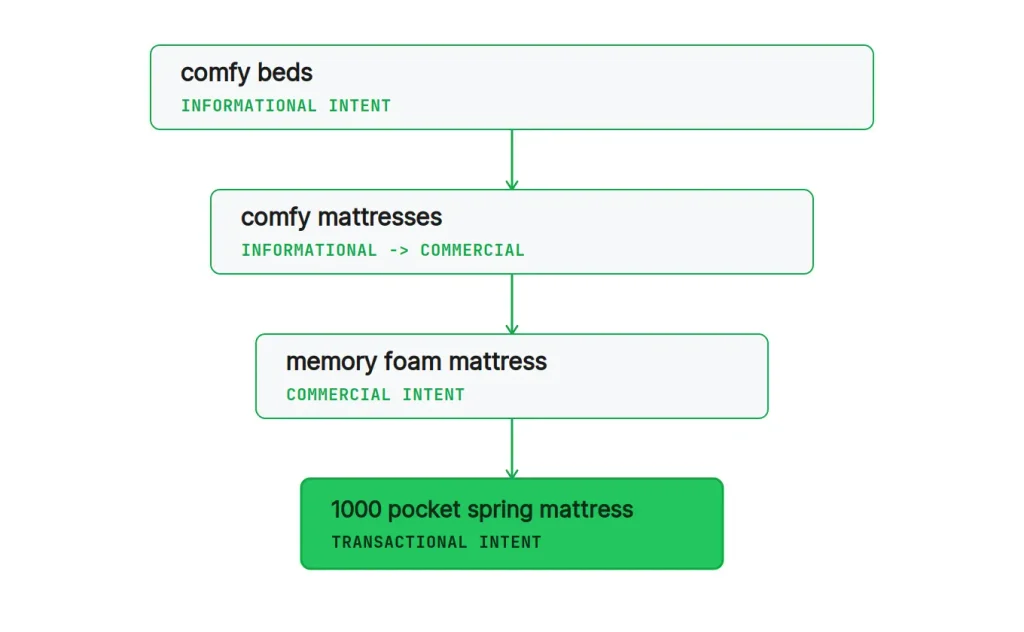
A user could begin by searching comfy beds.
Then they discover really they should be searching for mattresses, as they could be happy with their bed frame and just want a new mattress.
So the search develops into comfy mattresses.
They may do some reading and narrow it down to a memory foam mattress.
And in the end when they are at the bottom of the funnel, finish with 1000 pocket spring mattress or a direct product like Zumba pocket mattress 1000.
You see, at the top of the funnel the customer began with an informational or discovery query and as they moved down the funnel the search terms changed to commercial/transactional.
We want the information to be specific at the bottom of the funnel, we don’t want to hit them up with content designed for users at the top of the funnel, the objective here is to convert the customer.
Blurred lines
People are often lazy with initial queries and if you are familiar with PPC, we call these broad terms. They will often search shoes, beds, dresses, very broad in terms of subject.
These searches could be classed as commercial even though they sit at the top of the funnel, somebody searching for best shoes would also sit at the top of the funnel but with an informational search.
So people can sit at the top of the funnel using both informational and commercial keywords.
This is a correlation many don’t pick up on. Sure, many people may think they understand intent but they do not attribute the intent to a position in the sales funnel. This is why in ecommerce SEO it’s not enough to just understand intent, but where the user is in the purchase cycle, this helps us to optimise the pages better.
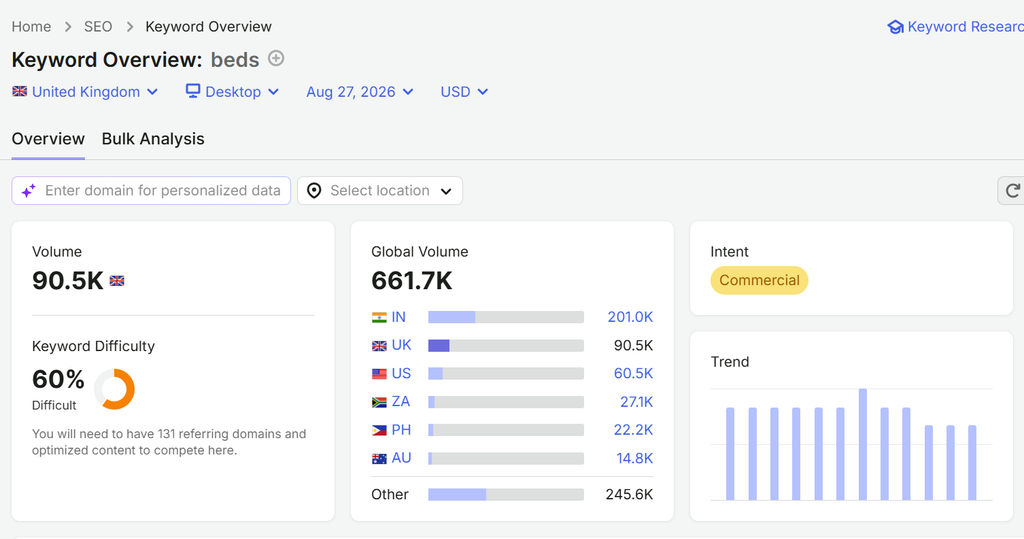
A user searching for beds sits at the top of the funnel with a commercial intent keyword, and another user sits at the top of the funnel using an informational search like best beds. Two different intents, both in the same position in the funnel.
See the example below of how Semrush tags a search for beds as a commercial keyword
Mistakes
When figuring out the intent of a keyword, just don’t take a tool’s judgement on it; check for yourself.
Traditionally, we know if a query is informational, we would set up a blog post on our ecommerce store, just like what you are reading now, a page meant to inform a user.
If you use a tool like Semrush and it says a keyword is informational, don’t just believe it, go and check for yourself.
Look at the pages that rank top, do they have products in them? Is it a collection page, a product page or a blog post?
You may even see the home page of a website ranking top for the query.
Home pages have a lot of weight in search engines; they are generally the pages that receive the most backlinks and can be a powerful source to distribute authority to inner pages.
If you find out a page is commercial or transactional, we know they want to do something, as in make a purchase. So you better have an add to cart button on the page and allow users to make a purchase, here we are matching the intent. The intent behind the search term is to buy a bed, so let them buy a bed.
What we don’t want to do is make the mistake of having a commercial page where a user is looking to make a purchase, but can’t actually purchase. And vice versa, if a user is looking for information, this is not the place to have a buy button; it should be dedicated to serving information.
Breaking it down
On ecommerce stores, we can break the website down from an SEO perspective into 4 areas:
- Home page SEO
- Collection page SEO
- Product page SEO
- Buyers guides/blogs/news
Typically we optimise the home page for branded search and navigational intent but it can also be a powerful page to collect broader commercial terms search such as beds for sale. Although if you do try to optimise your home page for a commercial term, be aware of competing pages on your site that target the exact same keyword; try to keep them distinct.
Collection pages are also used to target commercial terms such as double mattresses or king size beds.
Product pages are optimised for transactional queries such as “Zumba mattress 1000”, here we’re trying to catch people at the bottom of the funnel looking for that particular product.
This isn’t navigational though, a query only becomes navigational when someone’s aiming for a specific site or retailer, like “Dreams Zumba mattress 1000” or “Argos mattresses”. Searching for the product name on its own just means they know what they want, not where they want to get it from.
Structure is important
Did you know that optimising your product pages impacts your collection pages? Well it does, if you have a collection page called king size mattresses and it’s got mattress toppers and the odd bed frame mixed in with the mattresses, that dilutes the topical relevance of the page and it’s not going to be well optimised.
Think of it like a box called mattresses, when you open the box you see product pages, they all need to be mattresses, and variety is good. Red mattresses, soft mattresses, orthopaedic mattresses, geltex mattresses, latex mattresses.
We are giving the consumer choice, this helps to satisfy intent. If you land on a page and the choice is limited or poorly optimised, you are not satisfying the intent behind this query fully as the content, and therefore the information, is limited.
What to Do Next
I have seen some sites with an intent issue where they are matching the wrong page types to a keyword. My advice would be to Google the term you are trying to rank for and look at what pages are ranking top.
Are they selling a product and you have a blog post? If the answer is yes, your pages may not match user intent.
Do the same check for funnel position, not just intent. A page can match the intent and still be wrong if it’s aimed at someone bottom of funnel when the searcher’s only just started looking.
Take “memory foam mattresses” as an example here: commercial intent, someone comparing, not ready to buy a specific one yet. If that ranks a single product page instead of a category page, it might match the intent on paper, but we are landing a user who’s still comparing straight onto a product page, they are mid-funnel and a category or collection page is more suited.