
Headless Shopify Demo
This storefront demonstrates what you can expect when you strip away bloated Liquid themes and heavy apps, replacing them with a React-based storefront.
A Fast D2C Shopify Front End
Shopify is one of our favourite platforms. In terms of reliability, payment methods and overall simplicity, it’s up there with the platforms we recommend most to our eCommerce customers.
But for all the good it brings, it also has its limitations when pushed. Every time you add a new app, script or tool, the code on the front end can get bloated pretty quickly and page speed scores can suffer.
Page speed can be measured in lost revenue; a study by Potent estimated that a site that loads in 1 second has a 2.5x conversion rate compared to a site that loads in 5 seconds. That could be the difference between 100 or 250 sales a day.
When a user is browsing your products, we don’t want to give them time to think whilst pages are loading; we want them to land and convert with minimal disruption to their browsing experience.
By decoupling Shopify, we keep what it’s great at: managing products, processing orders, managing stock and providing a reliable platform for trading. But we substitute the weak point with a Next.js front end that delivers instant page transitions and frictionless browsing. If you just want a lightning-fast Shopify store that converts, this is for you.
The storefront
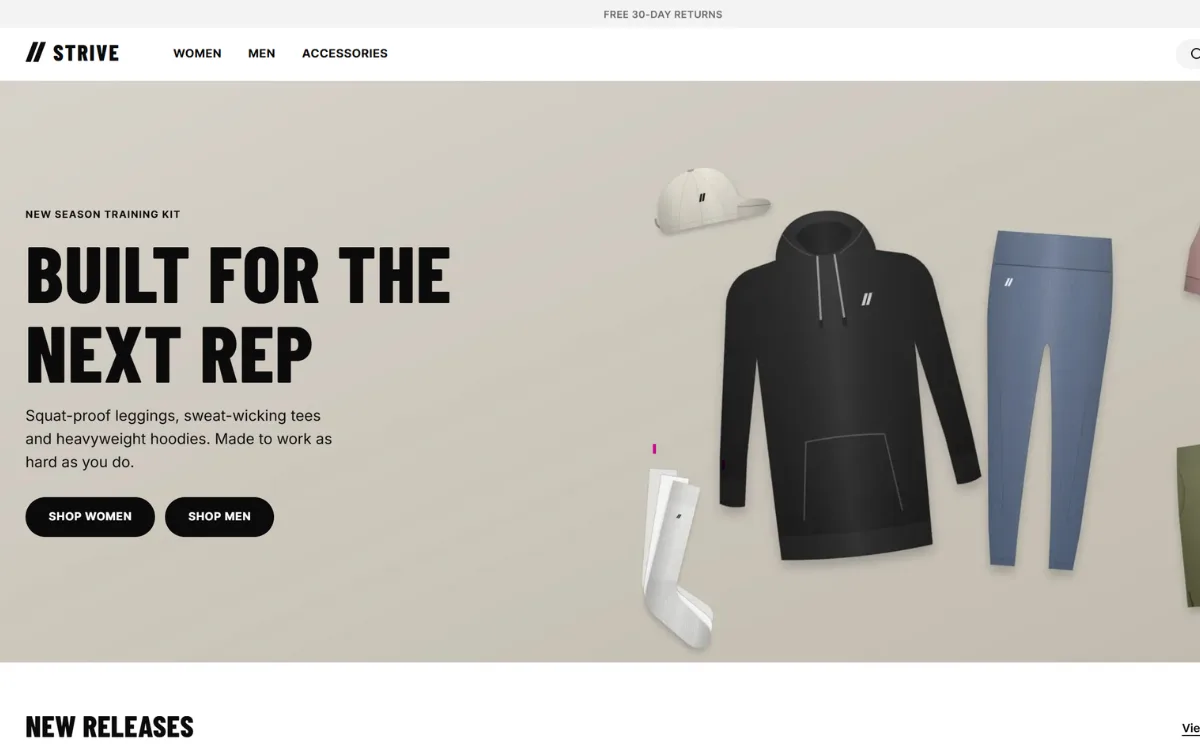
Shop it like a customer
Browse collections, switch colours and sizes, use the filters and add products to your cart. The demo is there to show the difference a headless storefront can make to the shopping experience.
View the live demoMobile PageSpeed score
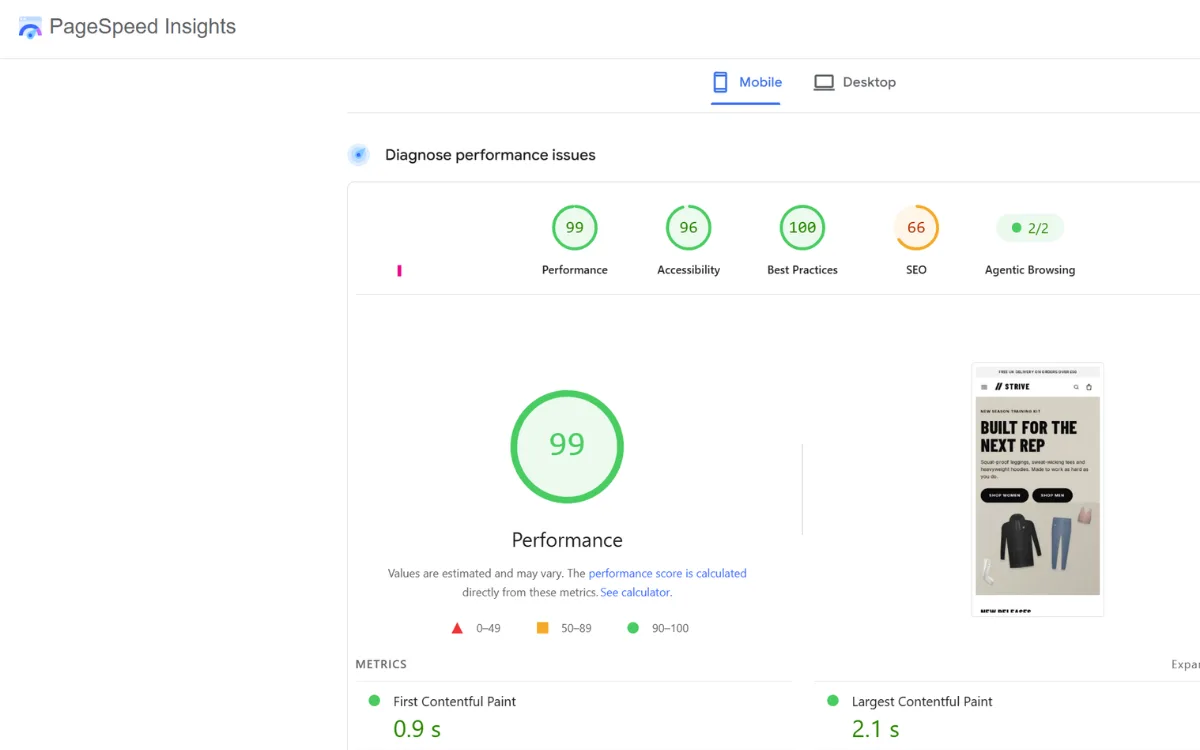
Test the speed yourself
Run the demo through Google PageSpeed Insights and see the score for yourself, then compare it against your own Shopify store. Results can vary slightly between runs.
Run the PageSpeed testThe SEO score is lower because we purposely keep the demo out of search results, as it isn't a live shop.
The Demo Inspiration
Our demo uses the same architecture as Gymshark. Everybody knows Gymshark is one of the most successful brands on Shopify. But what not everyone will know is that it runs a Next.js front end, just like in our demo. They use Shopify as the backend, and a decoupled JS front end, so that is what you will experience using our demo.
One of the benefits of a JS front end is that it is highly customisable. We can build any functionality for the front end without needing to run apps on every page of the site even when they are not in use, as you experience in standard Shopify setups.
Our headless development work isn’t tied to Shopify, and we can connect a front end like this to most ecommerce platforms. But if you’re already on Shopify, there’s often no need to move. You keep Shopify for products, orders and payments, and just replace the front end. Every platform has its limits as a business grows, and this is a way past them without a full migration.
The demo storefront STRIVE is a fictional activewear brand we have built to show what a modern headless D2C store feels like.
Instant page loads and navigation. Moving between collections, product pages, and accessories happens with zero page refresh.
Frictionless filtering and colour switching. Swatch changes and size selections update immediately without layout shifts or reloading.
Shopify Storefront API integration. Cart management, live stock levels, and customer accounts communicate directly with Shopify via GraphQL.
Server-side rendered for SEO. Google crawls fully rendered HTML directly from the server, protecting your Shopify SEO and organic visibility.
The site also uses a native Shopify checkout. When a shopper hits “Checkout”, they transition seamlessly into Shopify’s tried-and-trusted checkout to finish the sale.
The frontend
STRIVE is a fictional activewear brand we built to show what a modern headless D2C store feels like. Shopify handles the commerce behind the scenes, while the customer-facing storefront is built for speed, smooth navigation and a better shopping experience.
Instant page loads and navigation
Move between collections, product pages and accessories without full page refreshes. The storefront feels fast and responsive as shoppers browse.
Frictionless filtering and colour switching
Filters, colour swatches and size selections update immediately without reloading the page or shifting the layout around the customer.
Shopify Storefront API integration
Cart management, live stock levels and customer accounts communicate directly with Shopify through its Storefront API and GraphQL.
Server-side rendered for SEO
Google receives fully rendered HTML directly from the server, giving search engines clear access to products, collections and content.
Rock-solid Shopify checkout
When a shopper hits checkout, they move seamlessly into Shopify's native checkout to complete payment using the same secure system that powers standard Shopify stores.
Want to know why server-side rendering matters for rankings? Read about our headless SEO
The Tech Stack
STRIVE is built on a modern headless stack designed for speed, flexibility and long-term scalability. Shopify handles the commerce engine, while Next.js and React power the customer-facing storefront.
Next.js & React
The storefront is built with Next.js and React, giving us server-side rendering, fast route changes and a highly responsive interface without relying on a traditional Shopify theme.
Turbopack
Turbopack keeps development fast with quicker bundling and rebuilds, making it easier to work on and scale the storefront as new features are added.
Tailwind CSS
Tailwind gives us a lightweight and consistent styling system without loading a large theme stylesheet full of code the storefront does not need.
Shopify Storefront API
Products, variants, prices, stock levels and carts are pulled directly from Shopify using GraphQL, keeping Shopify as the central source of truth for commerce data.
Caddy web server
Caddy sits in front of the application as a fast reverse proxy, handling HTTPS, SSL certificates and modern HTTP connections automatically.
Shopify stays in control
Orders, payments, products and customer data remain inside Shopify. The headless storefront changes the customer experience without replacing the core commerce platform.
Things To Try in The Demo
When you access the demo, check the page speed and you will notice a difference to most standard Shopify websites. Instead of waiting a couple of seconds for some pages to open, you should notice a difference.
If you are familiar with Shopify, you will notice the checkout page is exactly the same; this is because this website is set up on a basic Shopify package to keep costs low.
- Open the storefront on your phone and tap through product categories, notice the instant page loads.
- Select an activewear item, swap sizes and colour swatches, and check the variant price updates.
- Add a couple of items to the bag and slide open the cart drawer.
- Click checkout to see the smooth hand-off to Shopify’s native checkout.
- Inspect the site using Google Lighthouse or Wappalyzer to see the clean architecture in action.
Real Results. Local Businesses.
Ecommerce brands we've helped grow through connected SEO, PPC, development, and automation.
Company
From Liverpool Supplier to One of the UK's Leading Workwear Brands
How we grew Work Uniform Company's monthly revenue by 900%, fully automated their order processing through supplier APIs, and took them to the top of Google for competitive terms like "work shirts" and "womens work trousers" on the Shopify platform.
Direct
Scaling Organic Traffic for Liverpool's Largest Bed Retailer
How we helped Bed Factory Direct, a Liverpool-based bed manufacturer and retailer with over 37 years in business, increase organic visibility and drive ecommerce revenue through a connected SEO and development strategy.
Driving Ecommerce Revenue for Liverpool's Iconic Home Store
How we helped Taskers, an established Liverpool home and furniture retailer with over 60 years of history grow their online revenue through an integrated approach spanning SEO, development, and ecommerce optimisation.
Why go headless with Shopify?
A standard Shopify theme works well for plenty of stores. But as your site grows, the theme and app stack can start getting in the way. Headless gives you more control over the storefront while Shopify continues to handle the commerce behind it.
Mobile conversion rates are lagging
Years of added apps, scripts and theme changes can drag down mobile performance. A headless storefront gives you much tighter control over what loads and when, helping you build around speed from the start.
You want total design freedom
You are no longer tied to the structure of a Shopify theme or its Liquid templates. Product pages, navigation, filters and buying journeys can be built around how you actually want the store to work.
International or multi-brand scaling
Run different regional storefronts, brand sites or microsites while keeping Shopify at the centre for products, orders and commerce data.
Keep the Shopify ecosystem
Going headless does not mean throwing Shopify away. Your team can continue managing products, orders, customers and payments in Shopify while the customer-facing storefront runs on modern frontend technology.








Frequently Asked
Common questions about headless Shopify development.
Back-office apps for inventory, shipping and accounting can continue working normally. Front-end apps such as review widgets, search tools and loyalty programmes may need to be connected directly through their APIs rather than loaded through a Shopify theme.
Shoppers browse and build their cart on the fast Next.js storefront. When they click checkout, they move into Shopify's hosted checkout to complete the purchase, with payment options such as Shop Pay, Apple Pay, PayPal and card payments still available where configured.
Not if it is built properly. Our builds use Next.js server-side rendering, so search engines and AI crawlers receive fully rendered HTML rather than having to rely on a purely client-side JavaScript application.
A bespoke headless Shopify build typically takes around 6 to 12 weeks. The exact timescale depends on the design, catalogue size, custom functionality, integrations and any third-party APIs involved.
Put your name in the book.
Tell us which parts aren't working. We'll reply within 24 hours, no hard sell.